Somewhere in every conversation about the changing world there is a moment when it stops being about the world. You are discussing what AI can do, and someone asks what their daughter should study. You are reading about another country’s visa rules, and realise that a plan your family has been making for three years now depends on them. You open a portfolio statement and wonder whether the number on it still means what it meant when you set the target. The questions have become personal before any of us has found the words for them.
The first three of these letters were written to institutions — to the boards deciding whether to commit to AI, and to the leaders who carry that decision into the organisation. This one is written to the person who goes home afterwards. Not as a board member, or an executive, or someone a few years into a career. To you as a person: with a family, a profession, some savings, a picture of the future that until recently did not need much revising — and commitments already made against it. An education under way. A household that needs the next salary. Parents who depend on you. A career into which you have put much of yourself. Now, time has come to revisit many decisions you made about you and your family’s future — because that future is changing but unfortunately, the ground on which you are making those decisions is still not fully set. It is still moving.
My initial letters described a world that has reset across four dimensions at once, and what that asks of institutions inside it. What they did not do is come down to the altitude at which the reset is actually lived — the kitchen table, the visa appointment, the portfolio statement, the phone call in a voice you know. This letter addresses that altitude — in two parts, of which this is the first.
OneThe World at Your Door
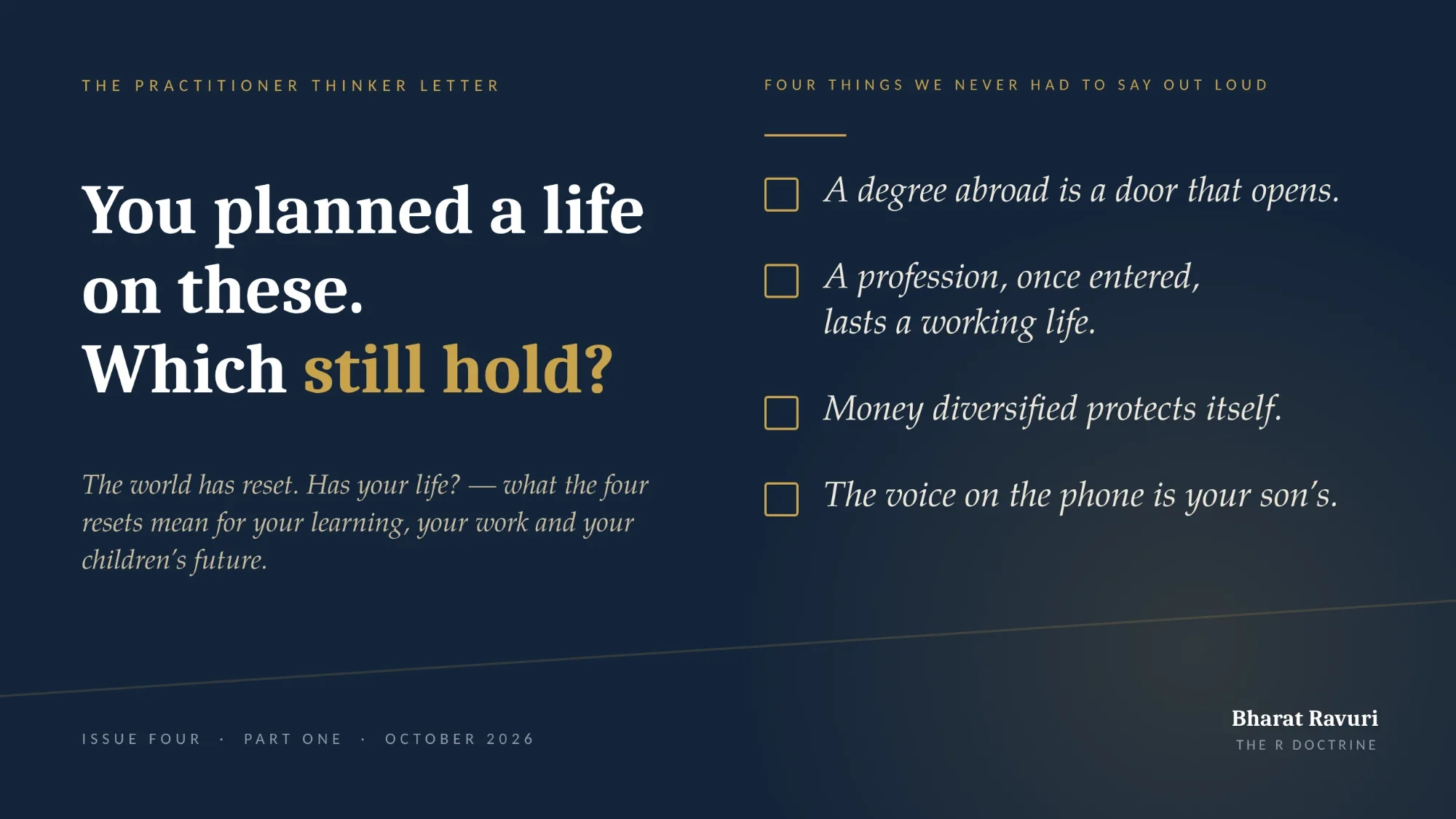
Most of us built our lives on assumptions we never had to say out loud. If you worked hard, and your child was good enough, a degree abroad was a door that opened. A profession, once entered, lasted a working life. Money diversified protected itself. And what you saw with your own eyes, or heard in a familiar voice, was a record of something that had happened. These were not beliefs. They were the ground — you planned a life on them without noticing you were standing on anything.
In the first of these letters I described four resets — geopolitical, technological, financial and risk — and how they cascade into one another at the level of nations and institutions. Each of them has now arrived at your door. Let us understand them — through an example.
The geopolitical reset. For three decades the world ran on openness; people, capital and talent crossed borders with fewer questions asked each year. That premise has ended, and nowhere does a family feel it more sharply than in the envelope with a university’s name on it. In the four months from May to August, when most of the year’s student visas are issued, the United States issued 58,694 student visas to Indian nationals in 2024. In the same four months of 2025, it issued 22,149. The admission letter is still real. The scholarship is still real. What has changed is that the door between them and the life they promised now opens, or does not, on grounds that have nothing to do with how good your child is. Earlier, a job after that education, in that country, was a reasonable expectation; that expectation has now disappeared. Geography and politics are, once again, first-order facts in the life of a family.
The financial reset. The money rules most of us learned were written for a calm world: some equities for growth, some bonds for safety, and when one falls the other holds. Through 2019 and 2020 stocks and bonds moved against each other, exactly as the rule promised. In 2022 they fell together. The S&P 500 lost nineteen per cent, and the ten-year US Treasury — the instrument meant to catch it — lost around sixteen per cent in the same year, as its yield went from one and a half to nearly four. They stayed together through 2023 and 2024, and on a three-year view they move together still. Spreading your money still matters. But the safety in it only ever came from the pieces not falling at once, and that is the part that stopped being true. More importantly, we cannot say definitively which of the pieces will move together and which will move in opposite direction.
A portfolio is only as safe as the correlations inside it.
The risk reset. The first letter described a world that has moved from a regime where the past is a reasonable guide to the future to one where the distribution itself keeps shifting. Here is what that means in a life: the base assumptions you lived by no longer hold. Your bank does not call to ask for your details. A video of a person is a record of what they did. The voice of your son on the phone is indeed your son. Each of these was a reliable fact, but each can now be manufactured and with technology/deep fakes, it is getting difficult to know what the truth is. In 2022, citizens in India reported losing ₹2,290 crore to cyber fraud; in 2024, ₹22,848 crore — ten times, in two years, by the Home Ministry’s own account to Parliament. Not because people became careless. Because the fakes became good, and the instincts that kept us safe were trained in a world where they did not exist.
The technological reset. And beneath the other three, the one you can already feel at your own desk: intelligence is being manufactured. Every earlier technology gave us better tools for our minds to work with. This one produces the work of the mind itself — on demand, at a cost that falls every year. The analysis that took you a week arrives in an afternoon. The code your child is spending four years learning to write is written, competently, by a system that costs less each month than a textbook. For the first time, the one thing that was unambiguously yours — a trained intelligence, and the twenty years it took to build — has a manufactured counterpart. That is not a productivity gain in your life. It is a change in what your life was priced on.
And they do not arrive one at a time. Take the decision many households are making this year: a child’s education abroad. The technological reset is changing the work she is preparing for. The geopolitical reset decides whether she will be allowed to stay and do it. The financial reset has moved what it will cost, in a currency that has moved, against savings whose purchasing power will have moved again by the time the fees are due. And if the household’s income sits in the same unsettled industry, the fallback you counted on is under pressure in precisely the month you need it. In the first letter I described how the four resets cascade into one another at the level of institutions. Here is the same cascade inside one family’s decision: a choice that looked as if it were about education turns out to depend on work, money and access, all at once. Seeing that does not make the ambition wrong. It makes the assumptions underneath it visible enough to examine.
Put the four together and the pattern is uncomfortable: a door that no longer opens on merit alone, a safety that no longer holds, a truth that can be faked, and an expertise that can be made. It would be easy to read this as a world closing in on the individual. I want to argue the opposite, and to earn it over the rest of this letter. The same manufactured intelligence that reprices twenty years of expertise places that expertise in the hands of anyone willing to learn to use it — you, and your child — at a fraction of what it once cost to acquire. The advantages that scale, credentials and capital conferred are being levelled at the very moment one person can build what used to need a team. The resets are not only taking things from us. They are handing the individual a kind of leverage no previous generation of ordinary people has held. What we do with it is the rest of this letter.
TwoThe Line Has Moved
Look again at the four examples. The door opened on merit; the profession lasted; the pieces of our savings moved differently; what arrived was true. We did not manage any of that. It was reliable, so we built on it — without noticing that none of it was in our hands.
What the resets have done is move that line — between what is in our hands and what is not — in both directions. And most of the anxiety people feel just now comes from still operating on the old side of it: steering things that have left their hands, and not yet noticing what has arrived in them. Some of what we counted on has moved out of reach, by decisions that are not ours. And some things have moved within reach that no ordinary person could hold before: the ability to learn almost anything from anywhere, to build what once needed a team, to go and get the truth rather than wait for it to arrive.
The first movement is loss, while the second is the largest transfer of capability to the individual in living memory, and it is happening at the same time.
To understand these changes and prepare yourself better, I’ll introduce a simple framework (three questions) and I’ll illustrate them across four dimensions — learning, work, money and risk. I’ll take the first two, learning and work, in this letter, and money and risk in Part Two — and I’ll repeat the structure on purpose across these dimensions: it is meant to be something that you can take home and ask of your own life, not something you admire once.
- Out of your hands. What, in this dimension of life, used to hold without your holding it, and no longer does? The right response is not to fight for it harder. It is to stop building a plan on it.
- Into your hands. What can you now do, decide or build here that was never within reach before? This is where the opportunity is, and where most of us have not yet looked, because we are still watching the first.
- Always yours. What here was never in anyone else’s hands — and has become more valuable precisely because so much around it is moving? This is what to protect, and what to invest in.
The answers will not be the same for everyone — they differ with age, with money, with health, with who depends on you. Someone supporting a household on one income cannot experiment on the terms of someone with savings and few commitments, and the same step can be an invitation to one person and a burden to another. So the aim, each time the three questions are asked, is not the boldest move available. It is the next step you can afford — in time, in money and in emotional energy — that leaves you better placed and better prepared for this new world.
ThreeLearning
Picture a Sunday evening in your house this year with both your children (your daughter pursuing her third year of university education, exploring a master’s, while your son, two years behind her, has started asking about careers). On the table is her application for a master’s abroad that was always the plan, and on your phone is the news about visa restrictions, technology changes and you both are wondering — whether the degree she is pursuing is still worth its value by the time she finishes. And you — who have advised her on every choice so far from a position of having been there and seen that — are discovering that you have not been there in this new world. Nobody has.
Out of your hands
The destination. Not the admission — her work and grades earned that, and it is real — but the door between the admission and the life it promised, which now opens or does not on grounds that have nothing to do with her. For thirty years, a family could plan around that door because it opened on merit; it was never ours, but it behaved as if it were. It no longer does, and the honest adjustment is not to fight harder for the door — more applications, a more persuasive statement of purpose. It is to stop building the plan on it: pursue the destination if it is right for her, but do not let the whole plan depend on it. A life planned around a destination that someone else controls is a life whose central decision has been handed to a visa office or a state department, and the resets have made that a poor place to leave it.
And something quieter is also out of your hands: the shape of the field itself. The thing she is studying will exist when she finishes, but not in the form she is being taught. Which parts of it will survive, which transform, which are absorbed into a system that does them on request — none of that is hers to decide or yours to predict. You can see it coming. You cannot steer it.
Into your hands
Here is what technological reset has quietly done. Ask what the degree abroad was actually buying? Three things, bundled: A capability, the network (people she would meet), and a brand (name of the institution on a page, telling the world something about her). The brand belongs to the institution and the network is at a destination that belongs to a visa office. But the capability — the actual learning — has become, for the first time, something a determined person can hold from anywhere. The lecture once given in one room to two hundred people is available to anyone; the “tutor” who cost more than most families could pay now answers at midnight for the price of a subscription; the laboratory of a software degree is a laptop. I am not saying a degree from a great institution stopped mattering — the people and the brand still matter, and for some paths, they matter enormously. I am saying that the part of it you most wanted your child to have — the capability — she can now have without the door opening. The decision on the table changes shape. It is no longer will she get in, but which of the three things does this path give her that she cannot now reach on her own — and whether that is worth what it costs, in money and in a plan that rests on someone else’s decision.
And then there is you. In the third of these letters I wrote, to leaders, that this technology cannot be understood by reading about it; it reveals itself only in use. That was true of leaders. It is true of everyone, and it has put something into your hands that no previous generation of parents held: the chance to learn the same new thing as your child, from the same starting line. Your advantage of experience — the things you have advised her from all her life — does not exist in this one domain. What you still bring is judgement — about people, consequences and what matters — and she will need it alongside her fluency with the tool. Every earlier transition between generations was taught downward: you knew, they learned. This one can be learned together.
How do you learn together? Sit with her and give AI the problem she is stuck on, and watch how she thinks with it — and let her watch how you do — give a problem you are stuck on and how you think with it. Have it argue against the plan on the table; both of you will meet the hard questions before the world asks them. Build something small together that solves a problem your household actually has. And apply one test to everything the system produces for either of you — not whether the work got done, but whether she can explain it, defend it against a different case, and say where it fails. Why is this critical? The same tool can be used to get an answer and be done with it, or push it to learn beyond what you could do alone. The person who does the latter is very different from the first. None of it needs a programme or a fee. What it returns is a capability you both hold, formed with contact rather than from reading — and an hour in which your child sees you new at something, and finding your way. In my view this collaboration/partnership is more valuable than anything else in this world.
Always yours
Most of what a curriculum teaches is content — facts, procedures, the methods of a field — and content is the thing manufactured intelligence does best. That has not made content worthless; it has changed what holding it means. What was once a career’s worth of knowledge is now a starting condition anyone can reach. What becomes more valuable, precisely because the content around it is now cheap, is the capacity that was the point of an education and never in anyone else’s hands: the capacity to think. To ask the question the system was not asked. To know when its answer is wrong, which requires having understood the subject deeply enough to argue with it. To decide what is worth doing at all. So the question for her learning is not which content to acquire but which capacities to build, and they are the same four whichever field she chooses.
- The ability to learn fast, without a syllabus, in a field that keeps changing;
- Judgement about what is true and what matters;
- The ability to direct manufactured intelligence at a real problem and know whether the result is any good;
- And depth in something — real depth, the kind that lets her argue with the machine — because depth is what turns a user of intelligence into a master of it.
These abilities are essential for success in the new world and no reset can reach them.
FourWork
There is a particular moment at work that many of us have had this year, in one form or another. A piece of work you would once have assigned to a capable junior — a first draft, an analysis, a model — comes back from a system in an hour, and it is good. Not perfect; good. And you catch yourself going through two thoughts at once: how much faster this makes you, and how many of the people around you used to be that junior — and what impact AI can have on them. At the same time, you probably are sitting with your son who is choosing what to study, and wondering about which careers are safe and how would the future impact the present decision.
Out of your hands
A job — salaried, nine-to-five job — was a place in someone else’s structure: you turned up, did the work as defined, and the structure paid you, insured you and told you what to do next. For most of the last century, it was the best deal available to an ordinary person, and it built the middle class in much of the world.
The organisation structure was built around human limitations — the limited memory, span and capability of the people inside it, which is why work was cut into roles and stitched back together with hand-offs and managers. I argued in the second of these letters that institutions will, in time, rebuild their work around what manufactured intelligence makes possible rather than automate the old structure as it stands today. When they do, the number of places in the structure changes. Not every role; not everywhere; not overnight. But the honest expectation is that the typical job becomes scarcer than it was, and the opportunities that depended on there being many of them become scarcer with it. How many, how fast, and in which fields is not ours to decide. Time will tell. There is no safe career to name — some may be impacted less than others.
Therefore, when it comes to choosing a career for your son, the world he is choosing in will differ significantly from the one he graduates in. A job that exists today will not exist in that form when he arrives. That is a fact to factor in. It is not a reason to stop choosing.
Into your hands
If the jobs become scarcer, the question is not how to compete harder for a shrinking number of them. It is what you can now do at work that you could not do before — and the answer is the largest change this letter describes. Building something of your own used to require a team, capital and years. Manufactured Intelligence has collapsed all three. One person with judgement and a real problem can now design, build and run what once needed a department. And I am sharing this from my own experience. I have built enterprise-grade systems that run on live market data, as a team of one with the technology as my collaborator, in months rather than years and large headcount it would have once taken. I am sharing this as practical evidence of something I want you to believe: the distance between having an idea and having a thing that works has never been shorter, and it is shortening in favour of the individual.
So, the shift I am asking you to consider — for yourself, and for your son at the table — is from preparing to land a job to building what you can do. For most people, that does not mean resigning on Monday. It means you treat your job as current host of a career rather than the career itself: deepening a capability until someone would pay for it directly, without an employer in between; building a body of work that exists outside of any firm; and starting, alongside the job, something of your own — small, unglamorous, solving one real problem for one set of people. This is critical — not because it will make you rich, though some of these grow, but because it builds the one skill the next decade will not stop rewarding: the ability to truly understand what “your” customer needs (understand the problem being faced by a set of people) and building something to solve that problem so that they pay you for it. Building this skill will protect you should your organisation change its mind on job displacements. More of us will work this way than ever before — not as a last resort, but because for the first time, it is within reach of anyone willing to learn the tools and these are cheaper than they have ever been, and are already on your child’s phone.
What does this mean for your son? The first drafts and the routine analysis were never only tasks; they were where a profession was learned. If a system now produces them, the learning has to be found deliberately — by asking how a conclusion was reached, what the customer actually needed, and why the exception mattered — because producing an answer quickly is an incomplete apprenticeship, and the people who notice that early will be the ones who will master their field early.
And if your own role has already changed, or ended, then the immediate needs are income, and the people around you — they come first. It is not an easy transition and the emotional roller coaster ride you go through is real and important. You do not have to turn this moment into a business; the next step may be another role, a new capability, or a small project that shows you what you could offer. Choose the one your present circumstances can carry. And if building is the step you choose, do understand that there has never been a better time to do something on your own, or build something for others, than now.
Always yours
Four things at work were never in the organisation’s hands, and most of us have never had to think of them as assets because we were paid anyway:
- A capability someone would pay for directly;
- A reputation, which is the market’s memory of that capability;
- The people who would call you if you were not where you are;
- And the habit of building things.
Take the organisation that you are part of away, and these are the capabilities you retain; they are also what the new world pays for, and each is worth more now than it was when organisations were reliable.
Let me illustrate that with an example: Think of the person who prepares the monthly operating review. Part of that work is assembling the pack, and the system now does it in an hour. The other part — knowing why a number moved, which explanation deserves scrutiny, what the room actually needs to decide, and whether last month’s decision was ever carried out — is the capability. It was always the valuable part; the pack was one expression of it. What has changed is that the capability has just been handed the time it never had, and the person who holds it has a choice about where to spend that time that the pack never allowed.
For your son they run forward. What will stay his in whatever he chooses — the four capacities from the last section, and above all the habit of building, because in a world with fewer jobs, the people who can build their own will be ones with the most choices. Choose a path that builds those, and the path can change underneath him without taking that capability away. Choose the durable over the specific. And have him begin now, making something that is his — small, real, and nobody’s to take back.
Before Part Two
Let me pause here. This letter has four dimensions, and I have taken you through two — learning and work. The other two — money and risk — are the ones people lose sleep over, and they deserve your full attention rather than the last ten minutes of it. So they are Part Two.
On money: you have probably looked at your savings and felt reasonably safe. In Part Two I will ask you to look again — at the part you worry about least, which may be the part quietly losing you money every year; at the “safe” half of your portfolio, which stopped protecting you in 2022; at your debt, some of which is now working for you; and at the two mistakes this new world punishes equally — acting too early, and not acting at all.
On trust: the voice of your son on the phone is your son. A video is a record of what happened. Your bank does not call to ask for your details. None of these is reliably true any more — and the money Indians lose to fraud has risen ten times in two years. So Part Two has to answer a question none of us has faced before: when anything can be faked, how do you know what is true? There is an answer, and it is simpler than you expect. It is a habit, not a technology. And Part Two ends where all four of these letters have been heading — with who you are when the title goes, and the one thing in your life that no reset, no machine and no fraud can manufacture.
Part Two reaches you on 1 November 2026. Until then, do not set this one aside. Here is what I would do this week with what Part One has given you: pick one — the one your week can hold. If you want a place to start, it is the hour with your child.
- 1 · Make AI part of your week rather than something you visit. Before your next major decision — a purchase, a plan, a hire — have it argue against you first. And use it to learn one thing you have been postponing.
- 2 · Sit with your child for an hour and give AI a problem neither of you can solve alone. Solve it together — then ask whether each of you can explain the answer and say where it might be wrong.
- 3 · Have the honest conversation with your son/daughter about what they are choosing: not which career is safe, but which capacities they will carry out of it whatever happens to the field.
- 4 · Write down the four things at work that are yours, not the organisation’s — the capability someone would pay for directly, your reputation, the people who would call you, and what you have built. Be honest about which are thin.
- 5 · Name one problem a set of people around you have, which you understand well enough to solve. Start something small toward it, alongside your job — this week, not this year.
- 6 · Take the messiest piece of your working week and rebuild it with AI beside you — not to be faster, but to learn from contact what this technology is and is not.
Each of these is small, and each is entirely in your hands. The world has reset. What you can learn and build has only grown. Begin this week — and I will see you in Part Two.
Part Two reaches you on 1 November 2026 — money and risk.
Subscribe to the Letter or follow on LinkedIn